June 15, 2022

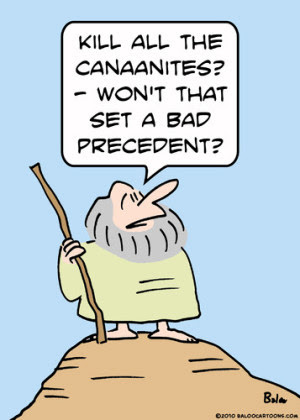
Saramago surely already knows...

No comments:

So the people shouted, and the trumpets were blown. As soon as the people heard the sound of the trumpets, they raised a great shout, and the wall fell down flat; so the people charged straight ahead into the city and captured it. Then they devoted to destruction by the edge of the sword all in the city, both men and women, young and old, oxen, sheep, and donkeys. Joshua 6:20-21

But if you do not drive out the inhabitants of the land from before you, then those whom you let remain shall be as barbs in your eyes and thorns in your sides; they shall trouble you in the land where you are settling. And I will do to you as I thought to do to them.  Numbers 33:55-56

In these texts of extreme violence, God not only orders the genocide of the Canaanites but is angry when some of them were spared. In Chapter 15 of the First Book of Samuel, we read that King Saul loses God’s trust, which is transferred to David, for having been too kind in sparing some Amalekites when God's command was to kill everyone, including women, children and the elderly.

The Old Testament is full of stories of violence that contradict the image of a compassionate and merciful God of the New Testament. This is the reason why the late atheist Saramago (the 1998 Nobel Prize winner in Literature from Portugal) said that the Bible was a violent book. Although fewer in number, however even in the New Testament we find some imperfections that could embarrass us.

History of Israel and the human nature

As far as the Old Testament is concerned, the Bible contains the history of Israel and the idiosyncrasies of the Jewish people, just as it has been throughout the ages. In this sense, the Bible is a literary work that is for the Jews what Camões’ The Lusiads is for the Portuguese and Shakespeare’s work is for the English.

In addition to the history and idiosyncrasies of a people, the Bible describes the fallen nature of the human being: the human being as he is, with his ups and downs, perfections and imperfections. Although inspired by God, the authors of the Bible did not sweep this fallen nature under the rug, because what is not taken on is not redeemed, as St. Athanasius later said.

The episode of the Pharisees bringing a woman caught in a blatant act of adultery (John 8:1-11) to Jesus can be read as a metaphor of what the Bible is: God's encounter with man, that is, the encounter of divine mercy with human misery.

From the beginning, right after the first sin, God did not abandon man to himself, but has been pedagogically accompanying him and sending him prophets, preparing him for His own coming as the model of human being to encounter the human being fallen into disgrace.

Jesus of Nazareth took on human nature, for he was like us in everything except sin, because sin does not belong to the human nature that God envisioned and created, but rather to the human nature that man ruined with sin. Jesus, God made man, takes on and accepts this fallen human nature, entering into fellowship with sinners, eating with them in their homes and walking in their company, without requiring them to change their lives. It is they who decide to change their lives when they find themselves unconditionally accepted by Jesus as they are, as seen in the episode of Zacchaeus (Luke 19:1-10).

You heard that it was said... But I say to you…
‘You have heard that it was said, “An eye for an eye and a tooth for a tooth.” But I say to you, Do not resist an evildoer. But if anyone strikes you on the right cheek, turn the other also; and if anyone wants to sue you and take your coat, give your cloak as well…’  Matthew 5:38-40

‘You have heard that it was said, “You shall love your neighbour and hate your enemy.” But I say to you, Love your enemies and pray for those who persecute you…’ Matthew 5:43-44

In the Sermon on the Mount, Jesus contrasts his doctrine, which he metaphorically refers to as new wine, with the doctrine of Moses and the customs of the Old Testament. He also establishes a new and eternal covenant that revokes the old.

Therefore, the norm for us is what the New Testament says and what in the Old Testament is in line with the New. In the latter, it is God himself, through his son Jesus Christ, speaking to human nature from within human nature. With Christ and his doctrine in mind, anyone who intends to use the Bible to justify acts of violence is misinterpreting it.

Read the Bible from front to back
And no one in heaven or on earth or under the earth was able to open the scroll or to look into it. (…) The Lamb went and took the scroll from the right hand of the one who was seated on the throne. (…) ‘You are worthy to take the scroll and to open its seals, for you were slaughtered and by your blood you ransomed for God saints from every tribe and language and people and nation…’  Revelation 5:3, 7, 9

Unlike other books, the Bible should be read from back to front. It is Christ, the Lamb who was slain, that can "open", that is, interpret, the Bible. It is from Him, the definitive word of the Father, that everything must be read, because everything points to Him. He and He alone holds the key to its interpretation.

The Bible must be read from back to front, that is, the Old Testament must be read from the New, from the perspective we acquire from reading the New. In this case, the key to interpreting these texts is the figure of Christ as the sacrificial Lamb of God.

Read the Old Testament in a metaphorical way
Taking this into account, the violent texts, especially those calling for genocide, can have a symbolic and metaphorical value. In this sense, Israel represents the will of God, the leaven of the Kingdom of God, the people whom God has called to begin the story of salvation with Him for all mankind. The enemies of Israel, the Canaanites, Philistines, Amalekites, Babylonians or Assyrians, are enemies to the universal plan of salvation. The struggle ceases to be physical and becomes spiritual.

When fighting against evil, call this for what it is, we cannot use half measures, because evil is not eradicated with half measures, but with radicalism so to uproot it. Wiping out Israel’s enemies, killing men, women, children and even their domestic animals now has the sense of eradicating evil at its root. Likewise, addiction to tobacco, alcohol or any other addiction is also not fought with half measures, but with radicalism and determination.

Conclusion: The late writer José Saramago, an atheist and the 1998 Nobel Prize winner in Literature from Portugal, must already know that God does exist and that the Bible is made up of two Testaments – the Old, representing man as he is and the New, man as he should be, in the image of Our Lord Jesus Christ.   

Fr. Jorge Amaro, IMC

June 1, 2022

What Is Religion Good For?

No comments:

There are fewer and fewer religious people in the world. Could it be that religion is good for nothing, and serves no purpose? What do statistics say about the lives of those who are religious compared to those who are not? Which group is happier? Which group is better prepared to face misfortune?

A call to self-transcendence
In ancient times, men gazed at the stars at night and this lifted their thoughts beyond the toils and worries of everyday life. A gaze that lifted them beyond themselves and the world to the transcendence will naturally lead to greater self-transcendence. In modern times, however, men no longer look at the stars, but at the television.

Television in general, during the peak viewing hours or the so-called prime time, presents prime-less programs. Far from being a call to self-transcendence, television leads man to meddle even more in the most immediate and urgent, in the day-to-day affairs. Someone once said that contemporary men walk in circles, at odds with each other, because they no longer look up to heaven.

In one village there was a boy who threw stones at the moon; of course, he never hit his target, but he was of all the boys, the one who threw the farthest. So, what apparently seemed to be a nonsense, like throwing stones at the moon, served a purpose, the purpose of self-transcendence, the purpose of becoming a better stone thrower. The same happens with religion, which apparently seems to serve no purpose but in the long run its effects are noticeable and undeniable.

Search for meaning
Religion is no longer present in people's daily lives, because it no longer explains anything and has no practical applications that make life better and more pleasant. Science, on the contrary, explains more and more things and has practical applications for everyday life that make our lives more comfortable.

Science indeed does explain many things, but it does not explain the most important thing: it tells us that the world began with a "Big Bang," but it does not tell us who caused this big explosion or what was there before, and the purpose of the Big Bang. It tells us that since that big explosion, the world continues to expand and will expand until it expends all its energy and dies, but it does not tell us what is beyond the end of the world. Most importantly, between the "Big Bang" and the end of the world, it does not tell us what is the meaning of life, for what do we exist or why do we exist.

It is true that we can very well live without these questions, like the agnostics do by burying their heads in the sand; they think that in ignoring these questions, is the best way to answer them. With this kind of attitude, there would be no progress in any branches of knowledge. Science is born from asking questions and looking for answers.

The spirit of a human being is like a child who has just attained the age of reason. By the age of seven, the child gains self-awareness and discovers that he exists. He then questions everything and everyone, searching for reasons to satisfy his restless spirit. Usually, he clings to his parents or some adult he trusts and bombards them with a succession of whys, looking for the ultimate or primal reason for the uncaused cause.

This often leads adults, who do not want to admit God as the uncaused cause and the primary reason for everything and everyone, to a dead end. At that point, they tell the child to shut up and call him a nuisance. Thus, the child stops questioning himself and questioning others, and like the adults who are his mentors, he puts an end to this exercise of seeking the whys of everything and is content to live in pure mundanity, as do the rest of the living beings who have also stopped questioning themselves.

Science and the rest of the knowledge and instances of society all disagree on the problem of death. Only religion presents a coherent solution. The most intellectual ones, like Karl Marx, say that it should not worry us, because while we exist, death won’t exist and when eventually death comes to exist, we won’t exist.... The more materialistic ones say to make the most of life as one only lives once.

The conflict between science and religion is like the conflict between love and money. Nobody denies that having money has always been important and is increasingly more so, because with it one has access to an ever-increasing number of comforts and pleasures. Despite the undeniable importance of money in living, everyone agrees that love is even more important. Money cannot buy love, but love can buy money; without money life still has meaning, but without love it has none.

Technology, spirituality and ethics
If science, the general theory of things, is translated through technology into practical applications that make our lives easier, then religion, an even more general and more encompassing theory than science, is translated into day-to-day spirituality and ethics.

Science through technology does not tell us how to live our lives but it does lead us to a form of materialism and consumerism, that is, to filling our homes with junk.

Religion not only gives meaning to life but through spirituality and ethics, it shows us the path that leads to the fullness of life, to self-realization, that is, to the happiness that we all desire. What technology is to science, spirituality and ethics are to religion.

If technology contributes to the material well-being of the body, then spirituality contributes to the well-being of the soul. While science and technology are concerned only with the material well-being of man, spirituality aims at the well-being of the person as an individual being, ethics aims at the well-being of the individual as a social being and as an integral part of a community.

Those who live in pure worldliness will say that both spirituality and ethics can exist and subsist without religion. In fact, this is the tendency of the postmodern man.

This takes us back to the inquisitive child we compared previously to the true spirit of the human being. Faced with an ethics without religion, we are forced to conclude that if what really counts is what goes on down here, there is no ultimate reason for things, and if there is none, why should I be good if being bad, I get more things, more money and more pleasures?

Spirituality without religion is comparable to Buddhism, the path to enlightenment, an individualistic and selfish personal improvement that inevitably leads to a society of elites and castes that still prevails in the homeland of Buddhism. Religion calls spirituality to altruism, to say that we ought to love others as we love ourselves; that is, whatever good that we seek for ourselves, we ought to seek it in equal measure for others.

Conclusion: Since human beings are naturally religious, life in pure worldliness is a polytheistic religion that consists of the love of power, fame and pleasure and sees money as Zeus, the father of the gods.

Religion makes us free from attachment to material goods when we love God above all things; it gives us the joy of living when we love ourselves as God loves us, it builds a just and peaceful society when we love our neighbour as ourselves.  

Fr. Jorge Amaro, IMC


May 15, 2022

Mary: The New Ark of the Covenant

1 comment:

Many of the titles that apply to Mary in the litany that we recite after the Rosary may have originated in the imagination and devotion of God's people. Mary as the Ark of the Covenant, however, has its roots in the Bible. This is how the evangelist Saint Luke presents her.

Origin and purpose of the ark of the covenant
As a general rule, Judaism rejects public manifestations of spirituality, preferring to focus on actions and beliefs. In fact, the story of Judaism begins with Abraham who, according to ancient sources, destroyed the idols that were the conventional method of religious observance at the time.

The worship of images or statues is severely condemned throughout the Torah; the greatest sin that the Israelites collectively committed was the construction of the golden calf (Exodus 32) which was intended to serve as a material intermediary between God and them.

But in the history of the Jewish people, there was one exception to this rule. One man-made object was considered intrinsically sacred – the ark of the covenant.

Built during the desert crossing, it was used until the destruction of the first temple. The ark was the most important symbol of the Jewish faith and served as the material and concrete manifestation of God’s presence on earth. The legends associated with this object – and the severe punishments handed out to those who abused it – confirm the ark's centrality in Jewish faith of that period.

The construction of the ark is ordained by God to Moses while the Jews were still encamped in Sinai (Exodus 25). The ark was a chest of two and a half cubits long, one and a half cubits wide, and one and a half cubits high. It was made of acacia wood overlaid with pure gold, inside and outside.

At the bottom of the ark, four gold rings were fastened, through which two poles, also made of acacia wood overlaid with gold, were placed. The family of Kohath, of the tribe of Levi, would carry the ark on the shoulders of two men.

The ark was covered by a kapporet or mercy-seat of pure gold, that was two and a half cubits by one and a half cubits. Fixed to the mercy-seat were two hammered cherubim, also in pure gold. The two cherubim faced each other turned towards the mercy-seat, with their wings spread out and touching, overshadowing the mercy-seat.

Legend has it that the ark travelled in front of the people, burning scorpions, snakes, and thorns with jets of fire coming out of it, thus preparing the way for God's people. It also accompanied the soldiers to war; in fact, it was once taken by the Philistines during a battle.

From a spiritual point of view, the ark was the manifestation of God's physical presence on earth (the Shekhinah). When God spoke to Moses in the tent of meeting in the desert, he did so from between the two cherubim (Numbers 7:89). After the ark was moved to the most sacred and private space of the tabernacle, and later to the temple, it became accessible only once a year and only to one person. On Yom Kippur, the high priest (the kohen gadol) would enter this space to ask forgiveness for himself and for the entire nation of Israel (Leviticus 16:2).

Mary is the new Ark
The Virgin Mary is the Ark of the New Covenant because, "The Holy Spirit will come upon you, and the power of the Most High will overshadow you; therefore the child to be born will be holy; he will be called Son of God." Luke 1:35

The description that Mary was covered with the shadow and power of God is the same and only description found in the passage about the ark that we read in Exodus: Then the cloud covered the tent of meeting and the glory of the Lord filled the tabernacle (Exodus 40:34). It was in the tabernacle that the ark was located.

The ark travelled to a Judean town in the hill country to stay in the house of Obed-edom (2 Samuel 6:1-11). Mary travelled to a Judean town in the hill country to go to Elizabeth's house (Luke 1:39).

David asked, “How can the ark of the Lord come into my care?” (2 Samuel 6:9). Elizabeth asked upon seeing Mary, “And why has this happened to me, that the mother of my Lord comes to me?” (Luke 1:43).

Dressed in a priestly vestment, King David approached the ark, and danced and leaped with joy (2 Samuel 6:14). John the Baptist, the son of a priest, leaped with joy in Elizabeth's womb at the approach of Mary, the new Ark (Luke 1:43).

The ark remained in the house of Obed-edom for 3 months (2 Samuel 6:11). Mary stayed in her cousin Elizabeth's house for 3 months (Luke 1:56).

The house of Obed-edom was blessed by the presence of the ark (2 Samuel 6:11). The word blessed is used 3 times in Luke 1:39-45 about Mary in the house of Elizabeth.

The ark returned to its sanctuary and eventually ended up in Jerusalem, where the presence and glory of God were revealed in the newly built temple (2 Samuel 6:12; 1 Kings 8:9-11). Mary returned home after visiting Elizabeth and eventually went to Jerusalem, where she presented her son to God in the temple (Luke 1:56; 2:21-22).

The contents of the ark
The final proof that Mary is in fact the Ark of the New and everlasting Covenant is given to us by the contents of the ark. What then did the ark of the Old Covenant contain, and what did Mary, the Ark of the New and everlasting Covenant, contain?

Old law and new law – Mary is the Ark of the New Covenant, for just as the old ark held the tablets of the law (Hebrews 9:4), Mary held Christ, the New law, in her womb. The old ark contained the tablets of the law, the Ten Commandments; Christ is the new law, the law of love which sums up the commandments and goes beyond, for he invites us to love without measure while the commandments only told us what not to do.

The manna is the true bread that comes down from heaven – Mary is the Ark of the New Covenant, for just as the old ark held the manna, the bread that came down from heaven (Hebrews 9:4), Mary held Jesus, the true Bread, in her womb, for while those who ate the manna died, those who eat the true Bread have eternal life.

The manna is the bread that the Jews ate only to go hungry again. The true bread is the one that, once eaten, makes us never hunger again; it is the true bread descended from heaven which is Christ. This bread was sown in the womb of Mary, as a song of Fatima says:

"The Wheat that God sown in Mary's womb has become for us the bread that gives us life and eternal salvation.... Mary is the ground where this seed germinates 100%. She is also the oven that baked him for nine months and presented him.”

The shepherds Moses and Aaron and the Good Shepherd – Mary is the Ark of the New Covenant, for just as the old ark contained the staff of Aaron and Moses with which they shepherded the people of Israel (Hebrews 9:4), Mary contained in her womb the new and ultimate Moses, the one who is the Good Shepherd, the one who lays down his life for his sheep.

If the old ark contained the staff of Moses with which he guided his people and worked miracles, the new Ark contains the Good Shepherd, the one who gives his life for the sheep and tells us that we must recognize only one authority, one Father, one Teacher, one Lord who is God.

Conclusion: If the ark of the covenant, which only contained signs of God's glory, was venerated, then Mary, the New Ark of the Covenant, must be doubly venerated for having contained God Himself.

Fr. Jorge Amaro, IMC


May 1, 2022

Theotokos or Mater Dei?

No comments:

A zealous Protestant convert gets on a bus and announces, "Here is the letter and here is the envelope that it was sent in, we keep the letter and throw the envelope in the trash. Christ is the letter, Mary is the envelope. "Is your mother also an envelope that you throw in the trash?" someone asked, and got no answer...

Up until the 5th century, the Church's reflection revolved around the identity of Christ. But even before the Council of Chalcedon in 451, in which Christ was defined as true God and true man, the Church’s reflection had already revolved around his mother. In fact, in as early as 431 at the Council of Ephesus, Mary was declared "Theotokos".

"Ave, Theotokos! Hail, Mater Dei! Hail, Hail Mary! Hail, Hail, Mary!" prays a canticle of Fatima, translating the Greek term "Theotokos" into the Latin "Mater Dei", but this is not the correct translation. "Theotokos" means God bearer which is not the same thing as mother of God.

History of human reproduction
Until the beginning of the 20th century, it was not known that a human being was the result of the fusion of two half cells – the sperm from a man and the egg from a woman – some time after the sexual act.

In the course of evolution from the appearance of Homo sapiens 5 million years ago to the present day, there was a time when the origin of a new human being was not known. With his less developed intelligence, primitive man did not apply the principle of cause/effect that associated the sexual act with the birth of a child nine months later.

During this period, although man had more physical strength, it was the woman who ruled the world, because it was from her and only her that the future of human species came; it was she and only she who ensured the survival of human beings. Societies were matriarchal at the time; even to this day, in all languages the words Earth and Nature are feminine words; God was conceptualized as a woman, as a great mother.

With the discovery of man's role in reproduction, society abruptly shifted from matriarchy to patriarchy. After all, a woman had no say or part in reproduction; rather, it was the man who put the new being inside of her, and she was only the fertile ground where it grew. God was no longer thought of as a mother, but a father, and man relegated woman to the background to this day.

The definition of Mary as "Theotokos" or God bearer is in agreement with what was thought at the time of the Council of Ephesus about the role of women in the act of human reproduction. A woman is only the fertile ground where the seed grows; it is the man who implants this seed, the sperm, which in itself was understood as a homunculus, that is, a small human being, but already fully complete. If this belief were still in force today, Mary would be, like all women, merely a "surrogate".

Holy Mary, Mother of God...
But when the fullness of time had come, God sent his Son, born of a woman, born under the law... Galatians 4:4    

St. Paul does not say born through a woman, but born of a woman. Mother is the one who welcomes a child into her womb and genetically contributes to its formation; Mary is mother in both of these senses.

Reading the incarnation of Christ in the light of what we know today about the origin of the human person, we can then say that the sperm came by way of the Holy Spirit, so that Christ was truly God, and the egg came from Mary, so that Christ was truly man. Now if Mary is the mother of Jesus and Jesus is God, then Mary is the mother of God; a perfect and undeniable syllogism.

She is not the mother of God in the sense that she is the origin of God, or that she is older than God and the origin of Jesus’ divinity. She is the mother of God because she welcomed God into her womb, and because she contributed genetic material to the human form that God took in Jesus of Nazareth.

Going back to the envelope metaphor
Mary is not only "Theotokos", God bearer; she is like our mother, who welcomed and carried us for nine months, and who also contributed half of the genetic material that formed us. Mary is therefore not only the envelope that contained God but she is truly the mother of God.

"Whoever my children kiss, my mouth sweetens". A mother is happy when people treat her children well and sad when they treat them badly; the same can be said of a son with respect to his mother. How can Protestants love the son and disrespect or ignore his mother?

Still using the metaphor of the envelope, lovers who keep their love letters, keep them inside their envelopes. Christ is God’s love letter to humanity. Mary is that flowery and colourful envelope that contains this letter; whoever is a mother is always a mother.

Furthermore, the envelop also contains the address of the person who sent the letter. We need it to respond to the letter, just as we need Mary's mediation because since she was the mediator of the primordial grace that was Jesus Christ, she is the mediator of all graces.

Conclusion: Mary is not only Theotokos, God bearer, because she welcomed Jesus into her womb; she is also Mater Dei, mother of God, because she contributed her own genetic material in the conception of Jesus. In this sense, Jesus is the flesh of her flesh, blood of her blood. If, so to say,  the divinity of Jesus comes from God, then his humanity comes from Mary.

Fr. Jorge Amaro, IMC


April 15, 2022

The Body With Which We Resurrect

No comments:

"This is all very confusing; explain to me, Father: when we die, our bodies go into the ground, our souls go to heaven, and we? Where do we go?"

Death as a passage - Easter
From the point of view of our faith, we should not use the word death as if it were a final destiny. The deceased are the dead; deceased means gone, finished, the end. This however is not true in the context of our faith.

In this context, death is not the last thing that happens to us, but the second to the last. Death is more a stage of growth, the passage from a spatiotemporal life to an eternal life beyond space and time. We believe there is life beyond space and time because God our creator of space and time and lord of life is himself spaceless and timeless.  

Even in nature death is never a definitive state, but a passage from one form of life to another. According to Lavoisier, in nature nothing is created, nothing is destroyed, everything is transformed. The death of one living being always gives rise to the life of another. Life is a perpetual circle of living and dying, because life feeds on life, every living being is the food for another living being.

The grass that rises from the soil dies between the teeth of the gazelle that feeds on it. The grass does not die, it is transformed into the gazelle, which then become a lion, and when this dies, it is eaten by vultures and hyenas, which then give life to countless worms, which in dying, fertilize the soil that gives rise to new grass and so the cycle repeats itself.

Death is not a state, but a passage. Those who have near-death experiences speak often of a tunnel and a light at the end of this tunnel. The same happens when we are born: there is a tunnel and there is a light; in Portuguese to give birth is translated literally as to give light. Our birth can be viewed as our first death, a death to the life we had in our mother's womb. In the same way, our earthly death can be seen as our birth into eternal life, in the bosom of God.

Death is a passage from one form of life to another form of life, from being in the womb attached to our mother by the umbilical cord to coming into the light, breathing for ourselves. Life is a gift from God, it is the air that we inhale through our nostrils that leads us to start living until the day we exhale that air and we return to Him.

The butterfly metaphor
In nature, there are living beings that change form during their lives. The frog is one of them, and the butterfly is another. The change of form also requires a change of environment, both in the case of the frog and in the case of the butterfly. The butterfly is born as a caterpillar that crawls on its belly across the earth, eating leaves until the day it apparently dies.

What seems to be a death is in fact only a change of form which while maintaining some similarities with the previous form, it is also startling different from it. Our life on earth is like that of the caterpillar, and our life in heaven is like that of the butterfly; our physical body is like that of the caterpillar, very attached to the earth, while our spiritual body is like that of the butterfly, freer, flitting from flower to flower.

The caterpillar is a metaphor of our earthly life, of our physical body that is dependent on the earth. Like the caterpillar, we drag our body across the earth, but we are called to a higher life, we are potential butterflies. To become butterflies and realize man's dream of being able to fly, we have to go through a near-death passage. We cannot be a caterpillar and a butterfly simultaneously; to be a butterfly, we have to stop being a caterpillar.

Life as a butterfly is flying on a warm spring day in a sea of different flowers with other butterflies of different colours, through fields, valleys and meadows, in the light of the radiant sun of the early morning hours, this is the life to which we are all called: Heaven.  

The water metaphor
Another metaphor that nature gives us that helps to conceptualize Resurrection is the three physical states of water. Water, without ceasing to be what it is, that is, without changing into another compound, exists in nature in three different states that are so distinct from each other that one might even think that they are three different compounds when we compare them to each other.

It comes from the ocean in the form of vapour that cannot be seen. It condenses and falls on the earth, penetrates it and springs up, forming rivulets, streams and rivers. It is buried and springs up again, flowing and forming rivers, giving life along its way, until it returns to the sea.

Instead of rain, it can fall in the form of snow; at zero degrees Celsius, it freezes, becoming hard as a rock; at 100 degrees Celsius, it boils and evaporates and, without ceasing to be what it is,comes into existence in the gaseous state, invisible to our eyes and intangible to our touch. We can see and touch it again if it condenses on a surface colder than the air temperature.  

If water, without ceasing to be what it is, can exist in an invisible and intangible form, we could say almost in a spiritual form, how can we who have a body that is made up of 70% of this element not be able to also exist invisibly and intangibly?

The 12 physical bodies of our life
The first living being that inhabited this planet was a single-celled being; there are still living beings that are single-celled, like the amoeba. The ontogenesis recapitulates phylogenesis, that is, the millions of years of the history of life on this planet recapitulates or repeats itself abbreviated in the individual history of every human being who comes into this world.

We too were once a single-celled being that was formed by a half-cell from our father, the sperm, and a half-cell from our mother, the egg. The two joined and we were formed, a human cell with a unique genetic code in the history of mankind; in a comparatively short time, this cell subdivided into other cells to form an adult human body consisting of 30 trillion cells.

Each one of our cells follows the general law that governs life on this planet: to be born, to grow, to reproduce and to die. This explains the growth and the aging of our body. In fact, with the exception of our brain cells, the neurons, all others follow this general rule – we can say that every 7 years we change, every 7 years we have a biologically different body.

Within an average lifespan of 85 years, we have 12 different bodies. With which of these 12 bodies would we be resurrected? With none of them, because it is not the physical body that resurrects, but rather the spiritual body which is a synthesis of all of them, but none of them in particular.

What is the spiritual body?
For we know that if the earthly tent we live in is destroyed, we have a building from God, a house not made with hands, eternal in the heavens. For in this tent we groan, longing to be clothed with our heavenly dwelling – if indeed, when we have taken it off we will not be found naked.  2 Corinthians 5:1-3

Putting it simply and bluntly, our spiritual body in heaven is made up of all the treasures that we accumulate throughout our life here, (Matthew 6:19-34). These treasures, these spiritual goods, which at the end of our lives form a body that is our history, are the good works, or what we have managed to spiritualize with our material resources and our spiritual talents.

People say that those who give to the poor lend to God, that is, the money or any temporal material good, when it is used for a spiritual purpose, becomes an eternal good, that is, it becomes spiritualized or an accumulated treasure in Heaven.

Using a metaphor that we all understand, our life is like a distillery. Distillation is a process by which material goods are evaporated by boiling, thereby removing their essence. To obtain the essence of a perfume, for instance, it is necessary to distill tons of a particular flower, thus acquiring a few drops of its essence. Alcohol resulting from the distillation of grapes or barley is called "spirit", whisky and brandy or cognac are thus called because they result from the distillation process.

This is a story about a woman who was accustomed to all the luxuries and flattery that this world can give because she was rich and famous. She died one day and when she reached heaven, St. Peter took her by the hand to lead her to her heavenly dwelling.

As they passed by many charming Beverly Hills-style mansions, the woman thought that she would be assigned to one of these. But they continued, reaching the suburbs and the high-rise buildings with apartments and she thought, "Well, it'll be at least one of those," but no...

Then they arrived at the slums of Heaven and St. Peter showed her a hut made of cardboard and tin. "This is your home," said St. Peter. "What?" said the woman, "that? I can't live in this dump!” "I'm sorry," St. Peter said, “but this is all we were able to build for you with the materials that you sent to us during your lifetime."

It seems to me that the more mysteries of nature science unravels, the easier it becomes to believe in a God who has made everything, and in a life beyond death. In the context of Newton's mechanistic physics, where matter is matter and energy is energy, it was hard to believe in the Resurrection.

With Einstein’s quantum physics, where matter and energy are one and the same thing, that is, that matter can become energy and energy can become matter, it is much easier to believe that our material physical body can become an energized spiritual body.

Fr. Jorge Amaro, IMC

April 1, 2022

Religion and Science

No comments:

“Science discovers; religion interprets. Science gives knowledge and power to men; religion gives them wisdom and control. Science is about facts; religion is about values. The two are not rivals, they are complementary. Science makes religion not fall into irrationalism, fanaticism and paralyzing obscurantism. Religion prevents science from falling into the swamp of obsolete materialism and moral nihilism."
Rev. Martin Luther King

Science and technology as the new religion
A growing number of people have been replacing faith in the omnipotence of God with faith in the pseudo-omnipotence of science and technology. Science discovers, technology applies, and our lives become more comfortable from a material point of view. In addition to material, the human person is also spirit, a spirit that questions the whys and the meaning of life and of everything around him. Science will never have answers to these questions, but religion does.

The agnostic will say that no one cares to know the "why" and the "for what". It is true, as the atheists say, that man is the moment when nature became aware of itself. However, it is precisely from that moment on that the human being began to seek the meaning of his life. Every individual, at the moment when he becomes aware that he exists, around 6 or 7 years of age, begins to wonder where he comes from, where he is going and what is the meaning of life; only animals do not do so, and it is only because they are not aware that they exist.

There are more and more people who have abandoned God in order to idolize science and technology. The idea that religion is nothing more than an ignorant and primitive way of investigating the mysteries of the world has taken root in public opinions nowadays. The episode of Galileo's condemnation earned the Church the reputation of obscurantist that prevails even to this day.

Galileo was condemned, on the one hand because the obstinate Church leaders of the time had not yet realized that the Bible does not reveal scientific truths, but only truths concerning human nature. On the other hand, as some historians say, Galileo did not present evidence to confirm his theory. Because we are on Earth, we do not perceive its movement and hence from this point of view, it seems that it is the sun that moves; the same happens to us when we travel in a car or a train – we who are in motion seem to be still, and the landscape that is fixed seems to move before our eyes.

Einstein was also criticized by some scientists of his time because his theory of relativity lacked empirical proofs, as it was an intuitive elucubration of Einstein's mind. It is only now that empirical evidences are beginning to appear that show the veracity of his theory.

Faith and reason
If God exists, then He exists as the Creator of everything and everyone; as creatures created by Him, it is not logical that our mind can encompass the mind of God, that the part can understand the whole. God can never be the object of science; for that matter, the same is true of man. In fact, the mystery does not involve only God and man, it is common to all areas of knowledge.

No science or area of knowledge can boast of having already discovered everything there is to know in its field; the more one knows, the more there is to know; therefore, the true wise man considers himself ignorant. Nicholas of Cusa called it the learned ignorance: in the face of the immensity of what there is to know, all I know is that I know nothing.

Science investigates nature; religion also investigates nature but more specifically, the nature of God. True science knows that the more one knows, the more there is to know. Religion also knows that but keeps on investigating the mystery of God, knowing that it can never encompass it in its totality.

Historically, reason has been constituted and instituted as science, which is the process of determining the behaviour of matter or of the universe using observation, experimentation and reason. Historically, faith has been constituted and instituted as religion, which is an organized system of beliefs, ideas or answers about the cause, nature and purpose of the universe that are not and cannot be the object of science.
 
Faith does not live only in religion, nor does reason only live in science. Faith and reason are complementary and we need both in our daily life. Practically every act contains a bit of reason and a bit of faith. In life, reason analyzes, faith decides. Without reason we would decide prematurely and make more mistakes than we already do; without faith we would never make a decision, nor risk a solution to our problems, because we would always think that something could have escaped our analysis and we fall into immobilism.

When I accept a cheque for a service rendered, in good faith I trust that the cheque is covered, it would be rude and I could lose a friend if I refused to take it and ask for cash instead. When I board a plane, I believe that the airport security has done a good job in preventing someone from putting a bomb in their luggage, and I believe the pilots are well trained and well-intentioned.

When I sit down to eat in a restaurant, I trust that the food is safe to consume and I do not demand that it be analyzed in a laboratory before eating it; it is this lack of faith and the fear of being poisoned that the cook in Ethiopia is made to always taste the food in front of the guests before a meal.

To know and to love
To know means to dominate and to control. If I know the principle that regulates rain, I can make it rain, as in fact the Chinese did a few days before the opening of the Olympic Games, to prevent it from raining on the opening day. With God, one cannot know Him in the same way. One knows God as one knows the human person.

A person only reveals himself, only makes himself known if he is loved. In contrast, if it is an enemy who knows us, we become vulnerable to him. Like all people, God only makes himself known to those who love him. We can’t love God or a person without getting personally involved with him. We cannot put God or a human person inside a test tube. To love is to implicate oneself with the beloved; among humans, knowledge without love is manipulation and control.

Church, society and science
In the case of abortion, it is the Church that is on the side of science, and the sociopolitical world, cultured or uncultured, that is against it. There is no scientist who denies that human life begins at conception, when half-cell consisting of 23 chromosomes – sperm – joins another half-cell consisting of the same number of chromosomes – the egg – forming an indivisible union, a human cell of 46 chromosomes with a unique, never seen, genetic code in the history of the universe.

This human cell immediately subdivides into replicas of itself, because all the cells that make up the human body contain the same DNA. Many people, following their conveniences, not science, decide that this embryonic life is not yet a human life, as if time could transform something that is not human into something that is human, or something that is not yet human to become human after a short time. Do these ignorant lovers of science forget that they themselves went through this embryonic phase and were they themselves not human at the time?

Abortion is a legalized homicide, a convenience for some, and a business for others. There is no scientific, moral or human basis for this killing and yet the science that knows that human life begins at conception also shuts up for convenience. This is Galileo Galilei of society and science, hypocrisy taken to its highest level.

The Church does not fear science
Far from fearing science, the Church even promotes it. The 19th century Augustinian friar, Gregor Mendel, is known to be the father of modern genetics. The only acceptable theory about the beginning of the universe is authored by Georges Lemaître, a Belgian Catholic priest. According to him, the "Big Bang" marks the beginning of Time, Space and Matter.  

Since in the universe as well as in nature nothing creates itself, it is perfectly plausible that it was God, someone outside of creation, the uncaused cause that by externalizing his creativity and love, caused an explosion of the atom he had previously created and, with this big explosion, created time, space and matter.

The Big Bang is the kick-off to an infinite succession of causes and caused, until it reaches the moment when a human being appears. Since the Church is not averse to science, Pope Pius XII, in his encyclical Humanae Generis, states that Darwin's theory of evolution of species is not in contradiction with the book of Genesis which, using mythological language, says that man was the last living being to be created. Whether it was created directly or as the end of an evolutionary process makes little difference.

The more science advances, the easier it is to believe. For centuries, the Bible and the Church have been ridiculed for speaking about the end of the world; today it is scientific to say that the universe had a beginning and will have an end. I firmly believe that science will never come to prove faith wrong, quite the contrary, the more science discovers, the easier and the more reasonable it is to believe than not to believe.

In which case not to believe will be reduced to a stubbornness that is more proud and ignorant than scientific or enlightened. We are not far from a time when we will be able to say, with all the scientific proof we have at our disposal, that only those who do not want to believe do not believe.

To speak of the miracles that Jesus did within the framework of Newton's mechanistic physics, according to which reality works like a perfect machine in the unalterable routine of a clock, is more difficult than to speak of the same topics in the framework of the theory of relativity and quantum physics, where there is no longer talks of fixed and absolute laws of nature, but of statistical probabilities. The Heisenberg’s uncertainty principle goes even further when it suggests that reality, far from being fixed and subject to routine, has a high degree of uncertainty and unpredictability.

For Einstein, matter is a form of energy, and energy is a form of matter; 95% of the universe is made up of dark matter that is invisible. How easy it becomes to speak about the resurrection, of the glorious body of Christ and of the spiritual body that we will possess after death!

Science tells us what the world is like and how it works; but the why of the world science can never find out because this is of another nature. 

Conclusion: Science discovers, technology applies, and our life becomes more comfortable. Religion discovers the meaning of life, ethics the values that define human nature, spirituality shows us the way to self-realization and happiness as sons and daughters of God.

                                                Fr. Jorge Amaro, IMC


March 15, 2022

Christianity, Islam and violence

No comments:

When his disciples James and John saw it, they said, ‘Lord, do you want us to command fire to come down from heaven and consume them?’ But he turned and rebuked them. Then they went on to another village.  Luke 9:54-56

(...) Indeed, an hour is coming when those who kill you will think that by doing so, they are offering worship to God. And they will do this because they have not known the father or me. John 16:2-3

Let us combine essence with existence, that is, let us look at what these two religions, Christianity and Islam, are in themselves with the history that each has written over the centuries since their inception. Of course, I write from my faith in Christ, the only Savior, the Way, the Truth and the Life for every human being, including Muslims; but I do not use faith as an argument; I hope to argue exclusively from the point of view of reason.

Fanaticism and violence
There are two concepts that have been perhaps misinterpreted, or interpreted in such a way as to satisfy, justify, and bless the thirst for power of some people. What is certain is that it was this "misinterpretation" of the concepts that wrote history and caused much bloodshed. I refer to the concept of JIHAD, which means effort, struggle, holy war and the concept of ISLAM which means submitting to the will of God.

As scholars say, JIHAD refers to the struggle that every human being must wage within himself against evil. The fact is that, historically, this inner struggle that was to remain interior has become an exterior struggle. In practice, this struggle has translated, and still translates today, into the struggle against those whom Islam considers as infidels, declaring a war against them that justifies itself because it is considered holy, supposedly for a good cause. At this time, they have not yet understood that "the ends do not justify the means".

Christianity also has its own version of holy wars, such as the Crusades. The first crusade was born in response to the request of the Christian Emperor of the East, Alexius I, to help him reconquer the holy city of Jerusalem and free the Eastern Christians from Muslim rule. However, it quickly became a way to halt the advance of the Muslims that threatened to end the Christian world. What began as a right to self-defence quickly turned into aggression, conquest, and massacre in the name of Christ.

ISLAM means submitting oneself to God; the basis of the Muslim religion lies in this submission which is symbolically represented by the physical posture that Muslims adopt when praying. This was the purpose of Jihad, the effort, the struggle to submit each one's personality to God; in fact, this is exactly what it means to worship God: to submit to his will.

As long as this principle did not depart from the personal sphere, as long as it remained reflective and intransitive, it was good and created no problems; but it is not this submission that history tells us about. Submitting oneself to God quickly turned into submitting others to one's version of God. Therefore, just as Judaism calls someone who is not a Jew a Gentile, Islam calls anyone who is not a Muslim an infidel.

Unlike Christianity which was born in an adverse world dominated by the Romans, and for five centuries was a clandestine religion that spread by the examples of the lives and preaching of Christians, Islam was born out of a belligerent conquest of Mecca and the forced submission to the new faith of the Christians and polytheists who lived there.

Islam quickly became confused with power and continued to spread not by preaching like Christianity, but by warlike conquests and trade. Muslims have in fact submitted the once Christian world to their faith: the southern and northern part of the Mediterranean Sea, by invading Europe from the west to as far as France and from the east to as far as Austria. Throughout the Middle Ages, they ravaged Europe, which closed in on itself into a feudal system.

After the Roman Emperor Constantine, Christianity became the state religion and as such, also used submission techniques not only in the torture of the Inquisition, but also as a form of evangelization.

In fact, to this day the Latin Americans accuse us of having evangelized Latin America more by the sword than by the crucifix; since the sword in the West has always been in the form of a cross, perhaps this is where the confusion comes from. Christianity has long abandoned these practices of violence that stayed in the Middle Ages; Islam still uses them today. Why?

Resentment against the Western Christian world
With the victory at the Battle of Lepanto between Christians and Muslims in 1571, Christian culture and civilization ended once and for all the constant threat of Islam and progressed to be what it is today, while Muslim civilization, whose peak had been reached with Averroes and Avicenna, stagnated into a medieval mentality.

The Muslim world has yet to recover from the resentment and hatred that this defeat had caused. This hatred motivates the actions of Al Qaeda, especially against the United States because the latter represents the Western world.

Currently, there is no traditionally Christian country that persecutes Muslims just because they are Muslims, while in traditionally Muslim countries, Christians are systematically persecuted: Egypt, Pakistan, Iran, Iraq, etc.

Muslims in the West are protected under democracy and the right to freedom of religion; Christians in the Arab world have no such rights; they are at the mercy of fanaticism. Muslims in the West can build their mosques; Christians in the Arab world have no right to build churches or repair the existing ones, and in Saudi Arabia they cannot even wear a crucifix around their neck.

He who owes nothing has nothing to fear
We are never as violent as when we are fighting for our survival. While the Christian religion, which has been called into question by the French Revolution, the age of reason, the Enlightenment and lately by atheistic philosophies, has progressed and survived, the Muslim religion opposes all critical thinking from within and from without, and threatens anyone who dares to do so.

He who owes nothing has nothing to fear: this aggressiveness is nothing more than a way to hide the serious deficiencies from the philosophical, historical and theological point of view. Fuelled by oil and hatred against the West, the Muslim expansion is like a giant with feet of clay – one day when these deficiencies come to the light of reason, perhaps no stone will be left unturned.

According to Carl Jung, fanaticism is a way to stifle an inner doubt. This is how Jung explained the fanaticism of St. Paul against Christians before his conversion. St. Paul's inner doubt was between the security provided by the Old Law, a false security, and the freedom of grace that St. Stephen offered.

St. Paul found himself torn between these two ways of living. On the one hand, he was comfortable living within the familiar boundaries of the Old Law, and on the other, he was attracted to the sense of freedom as he realized that he could never satisfy all the demands of the law, and that even if he could, he had no security or guarantee of salvation that would make the coming of Christ dispensable if man could save himself.

It is evident, just by the way they still treat women as second-class citizens, that the Muslim religion was fine for the Middle Ages, but not for the world today. As today's way of thinking can inadvertently seep in from many sources even in Muslim countries, through the television, the internet, these countries feel intimidated and fear losing believers, they fear that their religion will not withstand the clash of reason, as Christianity had to endure, reformulating itself.

Consequently, they become aggressive against the West, which is governed by reason that infiltrates from all directions since reason is the only way to development and progress. Since the West is of Christian roots, they turn against Christians living in their countries, calling them traitors and Americans, even though Christianity existed before Islam. They call Christianity a foreign religion, when in reality it was established many centuries before the Muslim religion came to their countries.

Animals show their maximum aggression when they sense their existence threatened. In this aspect, humans are no different. Cats are peaceful animals and never turn against their owners unless the latter threaten them and they have no way to escape. This is how the Muslim religion feels trapped in the face of the Western world of Christian tradition.

There are no reasons to kill
As mentioned above, the temptation to impose our belief or idiosyncrasy on others was already evident in the apostles. Jesus rejects violence as a means to an end. He also rejects killing in the name of God, saying that whoever does so has never known Him or God. God is Love and God is Life, not hate and death. For Jesus there are no reasons to kill, there are only reasons to die.

The difference between Islam and Christianity is simple: Christians follow their Master who taught them to die for a cause and who Himself died for the sake of justice; Muslims follow their prophet who exhorted them to kill for a cause and who himself killed for a cause.

At a meeting of Indians against the British Empire, before India's independence, a Muslim incited violence, urging those present to kill the British. To which Mahatma Gandhi replied, "For this cause [India's independence], I am willing to die; there is no cause, however, for which I am willing to kill."

Conclusion: Throughout its history, Christianity has experienced moments of violence, fanaticism and intolerance; Islam, however, has not yet discovered tolerance, dialogue and peaceful coexistence with the civil society and other religions.

Fr. Jorge Amaro, IMC


March 1, 2022

Islam, Reason and Jesus

No comments:

God created us as rational beings and as such, He cannot intend for us to relate to Him without the use of reason. We must have a minimum of assurance. Reason is to faith what salt is to food. Salt gives taste, gives meaning to food; similarly, reason gives meaning to faith.

Muhammad, the last prophet, Jesus, the son of God
Islam accepts as valid the Jewish religious tradition described in the Old Testament, which they also consider as their own. Muhammad is therefore the last of the prophets that God sent into the world, Jesus being the second last.

If humanity lives another 10,000 or 20,000 years, what sense does it make that the last prophet came in the year 524? More changes have taken place in the world and humanity since the year 524 than in all the millions of years prior. Why then before this date prophets came frequently one after another and then abruptly after the year 524, they stop coming and are no longer needed?

Long ago God spoke to our ancestors in many and various ways by the prophets, but in these last days he has spoken to us by a Son, whom he appointed heir of all things, through whom he also created the worlds. Hebrews 1:1-2

In the case of Christianity, even if humanity lives to the year 20,000, it makes sense that the revelation happened in year zero. As the author of the letter to the Hebrews explains, the one sent is no longer a prophet, but God himself who comes to live among us.

There is a qualitative leap here; prophets bring messages for a time, the Word of God is eternal for all times and all places, because God does not need to speak twice. On the other hand, Christ is not only a spoken word, he is a lived Word, and one lives only once.

In what sense is Muhammad the last prophet? Is it because Islam has a more refined doctrine and is on an ascending path, according to which, we have already reached the summit? But the top looks more like it belongs to Christianity which is all about inclusive love, even for one’s own enemy.  

Islam, in its practice and doctrine, resembles more the Old Testament than the New. A proof of this is the fact that while Jesus, 2,000 years ago, treated women equal to men, and did not allow the stoning of a woman caught in adultery, in the Muslim world today women are still being treated as second class citizens, and are still stoned for adultery.

If an impartial observer compared the Christian narrative, the New Testament, to the Muslim narrative, that is, the Quran written almost 600 years later, he would necessarily have to conclude that there is, by far, much more humanism in the New Testament than in the Quran.

Islam is in itself violent by nature because it is not about loving the God who loved us first, it is not about the love that is paid with love. God in Islam is the Lord of the Old Testament who commands submission. In human terms, no one loves the one who demands submission; where there is submission, there is no freedom or love. In contrast to this, Jesus says to his disciples: I do not call you servants any longer, because the servant does not know what the master is doing; but I have called you friends, because I have made known to you everything that I have heard from my Father. (John 15:15)

Historically, Muhammad, the founder of Islam, was a warrior; the religion itself started with the violent conquest of Mecca, it spread and expanded by means of wars, conquests and submissions of the conquered peoples, not by preaching like Christianity.

The meaning of the Incarnation of God
From the perspective of the Muslim religion and other religions, I can complain and say to God, "Listen, why don't you stop sending messengers and prophets, and come here and live under our human condition? It is easy to give advice; why don't you show us how to live the human life by being an example to us? Come down here and speak to us knowingly, that is, from within our human condition, after you have experienced in the flesh the cold, the hunger, the pain, the temptation, the pleasure, the injustice, the betrayal."

From the perspective of Christianity, however, I cannot uphold this argument in front of God, because Christ, despite his divine condition, became one of us, equal to us in everything except sin, to show us with his own life that it is possible to live the human life as God envisioned it before the fall of Adam and Eve.

Christ does not show us the way, the truth, and the life; He himself is the Way, the Truth and the Life. Within his person and with his life, we see what God is and what man is called to be. Christ is the weight and measure of the human person, the reference of humanity, because only He who was 100% God was also 100% man. Therefore, any individual who wants to attain happiness and self-realization as a person, it is to Christ that he must compare himself.

In other words, any person who wants to evaluate his or her own level of humanity, and how genuine he or she is as a human person, must measure himself or herself to Jesus, the only role model for all humans.  

In contrast, the life of the prophet Muhammad is far from being exemplary. In fact, Muslims themselves do not uphold him as a saint or a model to imitate. As a warrior and military chief, he carried out violence and committed war crimes when he had 600 Jews killed and enslaved their women and children.

He allowed his faithful to marry up to 5 times, but he himself married 8 times and had concubines, some of whom were minors; he had thieves’ hands cut off and the female adulterers scourged. Somehow, even for Muslims, Jesus the son of Mary is more important than he because it is Jesus, and not Muhammad, who will return to judge the living and the dead, just as we Christians believe.

"God is love", 1 John 4:8
No religion defines the essence of God so well as Christianity. But even if a religion had a formulation close or similar to this one, we know that love is like a coin on which one side is joy and pleasure and the other side is pain and sorrow. "Those who are obliged to love are obliged to suffer".

Since there is no love without suffering, from the Muslim perspective, that is, the way of conceptualizing the divine in Islam, how can God prove that he loves us if he has never suffered for us? In Christ, God suffered torture, betrayal, the abandonment of friends, and even the abandonment of his Father; he suffered for us and on our behalf what no man has suffered or will ever suffer: to feel condemned to eternal death under the weight of our sins.

Unlike Muhammad, Buddha and the other founders of religions who died old after a long life, Christ lived a short life, was condemned to death, tortured and executed. He embodied the new man in his life by being a role model for humanity and he paid with his own life for having faced the powerful exploiters of the people, of the poorest and the humblest.

God is one and triune, He is community
Islam inherited the simple monotheism of the Hebrews. Consequently, both Jews and Muslims have no way of theologically substantiating that man is made in the image and likeness of God. If God is love, and love that does not go out of itself is self-centered, but God is more than one; God is a family: Father, Son and Holy Spirit, and through Him we find the model of the human family: father, mother and child.

God is one and triune, just as a human family is called to be a unity of three persons, where the existence of one is not possible without the existence of the other two – a man is not a father without having a wife and a child; a woman is not a mother without having a child and a husband; and a child does not exist by himself without having a father and a mother.

As Christ is the model for individual human life, the Holy Trinity is the model for social human life: a model of peace, harmony and love. Judaism and Islam lack models, they lack a theological reference point for life in a family and society because they conceive God as a great loner.

Conclusion: Out of debt, out of danger, or, he who owes nothing, fears nothing.  If Islam thinks that it has no incoherence and inconsistencies that threaten its very existence, being a religion of submission then it should submit itself to the criticism of reason, as Christianity has done and continues to do. A faith that does not allow itself to be confronted by reason is not faith, it is superstition.

Fr. Jorge Amaro, IMC


February 1, 2022

Islam, reason and Mary

No comments:

The First Vatican Council defines faith as a "reasonable gift". Reasonable because it is plausible, it contains a minimum of reason, and it makes sense without ever being rational like positive sciences. Faith totally devoid of reason, is irrational and as such is pure superstition that, on practical terms, easily leads to fanaticism.

On the other hand, since the part cannot contain the whole, it is illogical that the creature with his limited reason can fully understand his Creator. Faith cannot be completely rational, and is therefore a gift of ourselves to God: it is to trust and surrender oneself unconditionally to the Other.

Western culture sits on a tripod formed by Greece, Rome and Jerusalem. Ever since it came into existence, Christianity has been the mentor, the “Mater and Magister”, the mother and teacher, of western civilization. Precisely because of this, in the process of emancipation it was and continues to be attacked by all instances of culture and social life.  

If there is one religion that is always under the severe scrutiny of reason and social criticism, it is Christianity. In my opinion, Islam has never been confronted by reason so has yet to pass through this purifying process, and for this reason, it contains many inconsistencies and deficiencies from the point of view of reason.

Historical and literary genesis of the Quran
The Quran was written in an ancient Arabic dialect, and the Muslims believe it to be the compilation of revelations made by Allah to the Prophet Muhammad (Mohammad) over a period of twenty-three years. The revelations were made in Arabic and, according to Muslim beliefs, through the Archangel Gabriel (Yibrail).

The Bible is a collection of books, each with its author inspired by God. However, it is the author who writes, so we must remove from these writings his individual character and personality, usages, customs and beliefs of the time if we are to arrive at the "ipsissima Dei verbum", that is, the real Word of God. Therefore, the idea that the Archangel Gabriel dictated the Quran to the prophet sounds like a fairy tale that is neither plausible nor humanly credible.

"Libris ex libris fiunt", books come from books, only God creates out of nothing. It is to be assumed that Muhammad would have extracted his ideas after a direct reading of previous revelations, Jewish, Christian and others. In his travels, the prophet met Jews and Christians and was familiar with the Bible, both the Old and the New Testaments.

From the Quran, it can be deduced that Muhammad was a Nestorian (Eastern) Christian who lived together in a Christian marriage with his only wife Khadija. Muhammad was one of the leaders in a power struggle in Mecca between Christians who wanted to eradicate polytheism and introduce Christianity and the rulers of the city who worshipped the traditional gods of Kaaba.

Muhammad’s strategy was to unite all the peoples of the Christian Bible, that is, both Jewish Christians and Eastern Christians, against the idolatrous polytheists. In 615, when the religious war in Mecca between Christians and polytheists became more intense, parts of Muhammad's group fled to their brothers in faith to the Christian city of Axum in northern Ethiopia.

In 622, Muhammad’s group of monotheists moved to Yathrib (Medina). Here the group began to unite Jewish Christians and Eastern Christians, like the Monophysite Nestorians, against the polytheists in Mecca. In 630, Muhammad’s troops finally conquered Mecca and took the Kaaba temple, converting it into a monotheistic shrine.

What the prophet intended was therefore a synthesis of Judaism and Christianity adapted to the Arab reality. He probably never thought of a new religion, so that if he were to return to earth today, he would not recognize himself in today's Islam. The same would be true of Luther and his Reformation, who never intended to create a schism in the Church – if he returned to earth today, he would probably not recognize himself as a Protestant; as a matter of fact, He died a Catholic.

Jesus and Mary in the Quran
With an entire chapter (sutra) dedicated to her alone, the Virgin Mary is the only woman referred to by her own name in the book of Quran. All other women are mentioned in relation to a male; for example, there are no references to Sarah, but to Abraham's wife. About Mary's virginity, the Quran clearly states that the one who does not believe in it or calls it into question is in sin.

According to both the Christian and the Muslim traditions, both Mary and the Prophet Muhammad receive a visit from the Archangel Gabriel who blows the Word into both of them. This Word in Mohammed became a book – the Quran – and in Mary, it became a man – Jesus of Nazareth. So that, some scholars of Islam say, Jesus or the Prophet Isa, as he is called in Islam, is the Quran in the form of a man and the Quran is Jesus in the form of a book.

Many Muslims may conveniently want to forget that when Muhammad returned to Mecca, he gave orders that all statues of idols be destroyed, but he himself ran to embrace and protect with his own body the statue of the Virgin Mary with her son Jesus on her lap.

Current Islam, to mark its differences from Christianity, ignores these facts, but what is certain is that even in the Muslim faith it is the Prophet Isa, or Jesus, the son of the Virgin Mary, who will return on the last day to judge the living and the dead.

Christianity and Islam are not irreconcilable and Mary could be the common ground on which peace and understanding would be established, not only between Christianity and Islam, but also with Judaism.

Mary's virginity in the Quran
Given these facts, let us look at the first contradiction and inconsistency in the Muslim religion – if for the Muslim faith, as it is for us, Mary the mother of Jesus is a Virgin, then who is the father of Jesus? It is obvious that it cannot be Joseph the carpenter, for if it was him then Mary could not have remained a virgin.

And if Joseph is not the father of Jesus, and Mary remains a virgin after conceiving, then the conception cannot have been natural and the father cannot have been human. If it is not the work of a human, then it must be the work of God, and if it is God's work then God has a son and it is not as Judaism and Islam conceives him, a lonely God, but how Christianity conceives him and how he was revealed to us by Jesus Christ, a God of love, expressed and lived in a family or community, the Holy Trinity.

Conclusion: Mary, the most well-known Jewish woman of all time, respected and loved by Muslims as the mother of the Prophet Isa, venerated and loved by Christians as the mother of the Son of God, can one day bring peace, harmony and understanding among the three Abrahamic religions. Being Fatima, the name of the Prophet Muhammad's favourite daughter, this could well be the fourth secret, hidden in the very name of the place where Mary appeared.

Fr. Jorge Amaro, IMC


January 15, 2022

God only blesses, Nature may curse

No comments:

I call heaven and earth to witness against you today that I have set before you life and death, blessings and curses. Choose life so that you and your descendants may live… Deuteronomy 30:19

Autonomy of creation
Influenced by an ancestral religious belief that when a calamity befalls us or others, we may not express it in words, but we always have the feeling that it was God's punishment, and we end up asking, "Did I do something against you, God?" or "Why is this happening to me?" To which I sometimes sarcastically reply, "And why not to you?" Anything can happen to any of us.

It was this idea that Job's friends tried to instill in him, "If all this tragedy has happened to you, losing your wealth, your health and your children, it is because you have done something against God who is now punishing you." Job professes his innocence and indirectly states that no one is free from tragedies, disasters, even though he has not broken any laws, neither God’s nor nature’s.

Creation is autonomous. God created it and gave it independence and autonomy, as He has done for us. God who creates nature with its laws, will not be the first to break them by capriciously intervening against these same laws. It is true that we no longer understand nature in the manner of Newton's physics, that is, functioning mechanically like a Swiss clock.

Even understanding reality as we understand it today in the manner of quantum physics, where the laws of nature do not always occur at all times and in all places in the same way but according to a statistical probability, even understanding a nature where there is room for chance, uncertainty and indetermination, nothing happens that God does not know and has not foreseen. Creation has a high degree of autonomy, but it is neither outside of God's design nor is God outside of it, for He is immanent, that means He is at the heart of everything that He has created.

God's punishments are human anthropomorphisms
The Bible in the Old Testament is full of episodes where God appears as vengeful and punitive: the flood (Genesis 6:9–8:22), the Tower of Babel (Genesis 11:1–9), Sodom and Gomorrah (Genesis 18:20–21, 19:23–28), and the ten plagues of Egypt (Exodus, chapters 7–12) among others.

The truth is that God does not punish anyone, God does not know how to punish, He does not know how to curse, He only knows how to bless, and He only wants what is good for us. The image we must have of God is the one that Jesus of Nazareth transmits to us. The Old Testament image is an anthropomorphism, that is, it is a way of imagining God in a human way. It is a human projection of God's identity. Since I am punitive and vengeful, I project onto God the image I have of myself.

For my thoughts are not your thoughts, nor are your ways my ways, says the Lord. For as the heavens are higher than the earth, so are my ways higher than your ways and my thoughts than your thoughts.  Isaiah 55:8-9

God is not responsible, nor is it willed by Him, the evil that happens to us, whether it be in the form of an accident, calamity or illness. God who makes rain fall on the just and the unjust alike (Matthew 5:45) loves us all unconditionally, He does not love the good more than the bad, nor the righteous more than the unrighteous.

Nature punishes
‘The parents have eaten sour grapes, and the children’s teeth are set on edge.’ Ezekiel 18:2

The fact that God does not punish does not mean that there are no punishments. Every good deed has a reward and every bad deed has a punishment. The rewards are given by God in the form of graces granted; the punishments are handed out by nature.

God always forgives, men forgive sometimes, and nature neither forgives nor forgets. What we do against nature, whether our human nature, individual and social, or the physical nature, will be paid for by either us or someone else somewhere down the line.

In other words, “what goes around comes around”; both the good and the evil that we do have a boomerang effect. As the Portuguese people are known to say, "evil stays with those who practice it", or even "what they do here is paid for here".

Take for example the consumption of alcohol: our liver has the capacity to breakdown a certain amount of alcohol, anything more than that amount will damage the liver and the consequences are always harmful, as we know. Sin is the e-mail, penance or punishment is the attachment.

The astronomical universe, whether that of physical nature, animal nature or human nature, is governed by the same laws; no one breaks these laws without paying the price.

At the individual level, therefore, what we do against our nature will be paid for by us or by some descendants of ours; what is certain is that someone will pay. Nothing is done against nature that does not have consequences. Punishment or penance follows sin, and is subsequent to it like the attachment of an email.

The planet's temperature is rising due to an excessive accumulation of carbon dioxide in the atmosphere that prevents the heat of the planet from escaping into the outer space thus trapping it in the atmosphere. Some consequences are already visible, but they will get far worse if we do not start to drastically reduce the emission of this gas.  

God adapts to us
God always writes straight on crooked lines.
Every cloud has a silver lining.


When we break a plate, God picks up the broken pieces and tries to put them back together. When Adam and Eve sinned, God did not just stand by unmoved and unperturbed, savouring nature’s vengeance which has turned against those who broke its laws, punishing them, instead He devised a plan to save them.

The prodigal son abandoned his father in search of a false freedom, and the father let him go, respecting his wrong choice, knowing full well that certain lessons are learned only experientially, by getting it wrong before getting it right.

Furthermore, we cannot force an adult to do good; a child who does not know the difference between good and evil, yes, we can force him to do good; for an adult, however, good has to be his choice, not an imposition.

God who, out of respect for our freedom, allows us to do evil, has no desire for revenge like the Old Testament tells us by means of certain anthropomorphisms. On the contrary, God the Father of our Lord Jesus Christ is a compassionate God, not even slow to anger, but completely devoid of it. Like prodigal children far away from Him, He never forgets or loses sight of us, He is always on the lookout in the hope we come back one day, and when we eventually do, He throws a party to celebrate our return.

The sheep ceases to be orderly and wants to be the black sheep. It leaves the flock, wanting to see what's beyond to discover new pastures, to experiment, and ends up getting lost. But the shepherd does not abandon it in the face of danger, and when he sees that it is lost in its quest and wants to return to the flock, the shepherd searches high and low until he finds the sheep. When he finds it, he puts it on his shoulders and rejoices; he and his friends throw a feast to celebrate its return.

We men killed the Saviour of Humanity, we were free to do so, but God who writes straight on crooked lines and who manages to draw good out of our evil ways, who always adapts to our mistakes, seeking the best solution for them, rose him from the dead to make him the first of those who are saved.

God does not want the death of the sinner. In the face of our evil, even deserved evil, He always seeks ways to save us from situations in which we put ourselves or others, or nature puts us. This happens because God is the supreme law and everything is subject to Him no matter how crooked our paths may be.

God, because He loves us and respects our freedom and our bad choices, lets us enter the tunnel of error and anxiously awaits us on the other side. And if He sees that we do not come out and are in trouble, whenever we call upon Him, He shows up at the appointed hour with the seventh cavalry to save us from the cobwebs we got ourselves entangled in.

Conclusion: God always forgives and forgets, He always blesses, never curses; nature, on the contrary, does not forgive, nor forgets and always punishes.

Fr. Jorge Amaro, IMC


January 1, 2022

The Sea of God and the River of Life

No comments:

In my Father’s house there are many dwelling-places. If it were not so, would I have told you that I go to prepare a place for you? And if I go and prepare a place for you, I will come again and will take you to myself, so that where I am, there you may be also. And you know the way to the place where I am going.’ Thomas said to him, ‘Lord, we do not know where you are going. How can we know the way?’ Jesus said to him, ‘I am the way, and the truth, and the life. No one comes to the Father except through me.’ John 14:2-6
 
Babies and small children are not aware of their own existence and often speak about themselves in the third person. When we gain self-awareness at the age of 6 or 7, that is, when we become aware that we exist as a human person, free and independent, we realize that we are finite, that we are, as Heidegger said, a being made for death.

It is around this time that we search for the meaning of our life and ask ourselves the three classic questions: where did we come from? Where are we going? What is the meaning of life? The agnostics say that they do not know, that they do not have enough information to answer these questions; the atheists say yes, they know, that they come from nothing, they go to nothing and no matter how much they search for the meaning of life, something that begins in nothing and ends in nothing cannot, by logical reasoning, be more than nothing. In mathematics, zero plus zero equals zero.  

The believers say that they come from God, they go to God and they live to give glory to God, putting the talents they have received from him at the service of humanity, thus reaching the full realization of themselves and the happiness that will never be complete in this life. Hence, Saint Augustine said: "You have made us Lord for yourself and our hearts are restless until they rest in you.”  

God and water: beginning of life
Life is like running water...

All rivers end up in the sea and the sea never overflows because it is from the sea that rivers are born. The water cycle is a metaphor of human life: life comes from God who is the creator of everything and everyone and life returns to God.

“In him we live and move and have our being.” Acts 17:28

Just as God is at the same time immanent and transcendent to all creation, the water contained in the sea is transcendent to every form of life, for it exists by itself, independent and apart from living beings. At the same time, it permeates them all, for there is no life without water. Paraphrasing the book of the Acts of the Apostles, it is in it that we truly live, move and exist from the physical point of view; from the spiritual point of view, it is in Him, God, that we live, move and exist. Water is the basis for physical life, God is the basis of spiritual life.

Human body is made up of 70% water, so let’s learn from it
On its pilgrimage through this world, water does not argue or go through its obstacles, it goes around them from above or below or from the sides; it always finds a way out. That is how our lives should be like: there are no problems without a solution and as the saying goes, what has no solution is already solved since it is not even a problem, because every problem has a solution.

We can live without a leg, without an arm, without a father, without a mother, tied to a wheelchair, as paraplegics, quadriplegics. Like water that flows around and flows back again, so must we when faced with a misfortune go around and not rebel against the situation, and rediscover the meaning of life. There must be no room for despair, suicide or euthanasia. Stephen Hawking, who in his lifetime was regarded as the smartest person in the world, lived in a wheelchair, could only speak with the aid of a computer and had very limited mobility of his arms and hands.

“Waters passed do not move mills”, it's water under the bridge. Just as water once passed, no longer moves the mill that was left behind, let us leave the past in the past, let us not allow it to negatively influence or jeopardise our present.

Water cycle and life cycle
Water is contained in the sea; this is the largest reservoir where all water ends up and from where all water comes. With the help of winds and tides, seawater evaporates and, in the form of water vapour, is carried by the same wind to the atmosphere above the earth. There it condenses into droplets of pure water which then fall on the earth in the form of rain, snow, frost and dew, and penetrate the earth, forming rivers and underground water tables.

Subsequently, this water emanates from the earth in the form of springs, also called streams, of which the larger ones give rise to a river. Like water, before we were born, we already existed in the mind of God; and as the water that was pure incarnates in a "body" consisting of the mineral salts of the earth that houses it, so do we, pure in the mind of God, acquire a physical body genetically in conformity with that of our parents who conceived us.
    
Like a river that starts small and grows bigger with the help of its tributaries, streams, rivulets, brooks and other rivers, so do we grow in stature and character with the help of our parents, our brothers and sisters, uncles and aunts, teachers, catechists, doctors, etc. There are rivers that sadly do not reach the sea, they are lost in the heat of the desert sands; just as there are lives that are lost, that fail to reach their objectives and are extinguished.

A river may already have a great inflow, but it can always receive more water, even from small streams. In the same way, we learn until we die; there is no one so poor that he has nothing to give, and no one so rich that he has nothing to receive.

Like a river, we cannot stay still no matter how beautiful the view is, because we don’t have a permanent dwelling here. We can even form a lake like the Jordan River forms the Sea of Galilee, but the water flows out and the Jordan continues to the Dead Sea which is dead not because it does not receive, but because it does not give. The Jordan River dies in the Dead Sea because, unlike the Sea of Galilee, it does not flow out and continues to the Red Sea, it stays still.

Along the paths of great rivers, large dams are built, huge concave walls to retain the force of the water. This force is routed or sublimated in the form of canals to irrigate the fields and give life to the rural area or harnessed in the form of electrical energy to make urban life possible. In our lives we also need great restraints of our basic instincts, great sacrifices and penances so that this energy is channelled to achieve high personal, cultural and social goals and benefits. Nothing worthwhile in life is achieved without effort, sweat and tears.

In deltas or estuaries, rivers finally reach the sea after a long journey of thousands of kilometres, like the Nile River. Whether a short life or a long life, our life will also come to an end one day; as water lets itself go into the sea, to die is to let oneself go back to the bosom of God where we have already been.

For as the rain and the snow come down from heaven, and do not return there until they have watered the earth, making it bring forth and sprout, giving seed to the sower and bread to the eater... (Isaiah 55:10), so must we also not return to heaven empty-handed, but with the fruits grown from the seeds that were the talents that God gave us. To die is therefore to return home; a return with shouts of joy, carrying our sheaves (Psalm 126:6).

To live is to leave
From the beginning of creation, “God made them male and female.” “For this reason a man shall leave his father and mother and be joined to his wife, and the two shall become one flesh.” Mark 10:6-7

For those whom English is a second language, there is a tendency to pronounce "live" and "leave" in the same way. Inspired by this fact I came to the conclusion that to live is to leave, requiring of us a continuous letting go. Life begins when a man and a woman leave their respective home to form a new one together.

In the conjugal act, an X or Y sperm cell rushes to join the ovum and the two form one flesh, as the scripture on marriage says. Once this primordial cell has been conceived in the fallopian tube, life requires that it leaves this space and migrates to the uterus where it remains and grows for the next nine months.

Nine months later when the baby is fully developed, life requires that it leaves, it cannot remain in the womb because it will end up killing itself and the mother. Leaving with labour pains, he or she is welcomed into a larger womb that is the family where the baby feels the unconditional love of parents and siblings. However, in order to continue to grow, to live, he or she has to leave this environment of unconditional love to go to primary school where love is no longer unconditional. There is no child who does not cry on the first day at school.

When the child has become familiar with the school and it has become like a second family, he has to leave it behind to go to a secondary school. Then he leaves this one also to go to a university, which may require leaving his homeland too, because there is no university where he lives. Many emigrate to go to another country for a better life.

And everyone who has left houses or brothers or sisters or father or mother or children or fields, for my name’s sake, will receive a hundredfold, and will inherit eternal life. Matthew 19:29

The Hebrews became a people when they left slavery behind in Egypt, crossing the desert towards the Promised Land; this is the archetype of all types of progress, from the scientific to the spiritual. To be a disciple of Christ one must also leave. There is no growth of any kind without dying to the former life. A snake, in order to grow, has to shed the skin it had before. To grow means to die; this explains the physical growth of our body; some cells die to make room for others. From the biological point of view, every seven years we have a different body, because none of the cells that made it up seven years ago exist now.

Leaving life throughout the world in bits and pieces
This has been my motto since I became a missionary. Since I was 10 years old, I have never been in the same place for more than 5 years. I have lived in various places in Portugal, then in Spain, England, Ethiopia, Canada, Israel, and the United States. Instead of living my whole life always in the same place and with the same people, I live my life like a pilgrim, leaving pieces of myself here and there to be picked up when I reach the Promised Land of Heaven.

Conclusion: There is no life without water. The water cycle, that begins and ends in the sea, mirrors the life cycle, that begins and ends in God. By water, we live, move and exist physically; in God, we live, move and exist spiritually.

Fr. Jorge Amaro, IMC